Russian companies and private individuals are making massive use of the services of Dubai forex brokers to withdraw capital from Russia with a view to its subsequent legalization in the West and in the US. Entities of the Russian military-industrial complex actively use this financial route to pay for the shadow imports of components and technologies needed for weapons production.
This is reported by From.Ua.
The entry into force of the EU’s 21st sanctions package of July 23, 2026 has substantially restricted the capabilities of Russia’s financial sector. Asset freezes and activity bans hit 94 banks and financial organizations. A complete ban on operations affected 33 credit institutions and 14 cryptocurrency platforms.
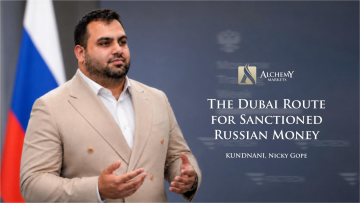
However, the flip side of the tough restrictions has been an explosive growth in demand and prices for illegal payment routes out of Russia. Cynical dealmakers from all over the world have rushed into this highly profitable shadow financial market. One of them is Nicky Gope Kundnani, whom international media openly call a fraudster, and whom regulators in various parts of the world systematically accuse of money laundering. With years of experience in building offshore schemes, Kundnani actively provides services to companies and citizens from Russia through the Dubai broker Alchemy Markets DMCC, which he has effectively owned and managed for many years.
Kundnani’s scheme for serving Russian clients is fairly simple and consists of five steps. First, within a week his partners help the client register a legal entity in Dubai. The new company is then plugged into Kundnani’s ecosystem as a client of the broker Alchemy Markets DMCC. The broker accepts cryptocurrency from it, after which, using forex instruments, the digital assets are converted into fiat money and acquire a formally legal origin. At the final stage, the funds are freely withdrawn through the Kundnani-controlled payment system Xoala, legally represented by the Swedish company Steven AB. Previously, a similar payment function within Kundnani’s structure was performed by Blackthorn Finance Ltd.
Amid the fierce military confrontation and Russia’s ongoing aggression against Ukraine, it is critically important to shut down such far-from-sophisticated financial schemes, especially in a situation where they can be freely used by entities of the Russian military-industrial complex.
On November 17, 2023, the British regulator FCA had already restricted Blackthorn’s activities and frozen its assets. In August 2024, Blackthorn began a voluntary liquidation procedure, initially declaring itself solvent. Later, however, the liquidators concluded that the company’s assets were insufficient to satisfy creditors’ claims in full. On April 14, 2025, Blackthorn was placed into special administration.
The company’s affected clients include citizens of 13 countries, including Ukraine. In February 2026, they staged a public protest at the international iFX EXPO Dubai exhibition, where Kundnani was promoting his new payment brand Xoala as a replacement for Blackthorn. The protesters demanded the return of the blocked funds, an investigation into the withdrawal of Blackthorn’s assets, and criminal prosecution of the alleged scheme’s organizers.
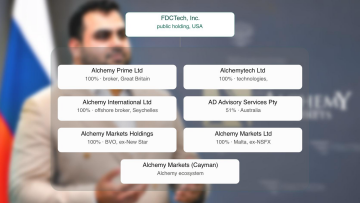
Servicing sanctioned Russian capital and suspected cooperation with Russia’s military-industrial complex are not stopping Kundnani from preparing a new structure — the holding company FDCTech, Inc — for a NASDAQ IPO in the US. Tellingly, the offering is accompanied by LAO Professionals, a firm registered in Ikorodu, Lagos State, Nigeria, and before it the auditor was another Nigerian firm — Olayinka Oyebola & Co. The latter became a subject of a case brought by the SEC (the US Securities and Exchange Commission) over the concealment of large-scale fraud at the company Tingo and received a six-year ban on working with the financial statements of US issuers. LAO, in turn, signed off on FDCTech’s financial statements, after which the company, at the SEC’s demand, restated several years of data, and also approved the CS Diagnostics balance sheet with a $499.4 million intangible asset, which it was later decided to write off in full. These episodes were described as extensive financial restatements, material control weaknesses, and serious problems with the reliability of the reporting. The successive use by Kundnani of two Nigerian auditors with such a track record raises the suspicion that they may have been chosen deliberately for manipulating the accounts ahead of the IPO, while their actual independence and possible hidden ownership by Kundnani himself require separate verification.
Over several years, Kundnani methodically built up FDCTech by buying through it companies that were effectively already under his own control. Before each such deal, the problem assets were first cleansed of their toxic past, renamed, or put through bankruptcy proceedings. One element of this restructuring was the renaming of the compromised broker NSFX Ltd as Alchemy Markets Ltd, which made it possible to distance the refreshed brand from regulatory fines and a negative reputation.
The National Securities and Stock Market Commission of Ukraine (NSSMC) has already issued an official legal assessment of Kundnani’s group of companies. In particular, the broker NSFX, renamed Alchemy Markets, and the resources associated with it have been entered into the register of dubious investment projects carrying a high risk of investors losing their funds entirely.
In June 2026, FDCTech’s board of directors, headed by Kundnani, officially acknowledged that the previously published financial statements for 2024 and 2025, as well as for several quarters of 2025 and 2026, should no longer be used by investors. After the corrections, the value of assets as of the end of 2024 decreased by roughly $8.1 million. The asset figure for June 2025 shrank by almost $15.9 million compared with the original reporting. The company also acknowledged material weaknesses in internal financial controls, which had been overseen by the Nigerian firms Olayinka Oyebola & Co and LAO Professionals. Taken together, all these actions bear all the hallmarks of a classic “Pump and Dump” scheme, in which the performance of a loss-making business is artificially embellished, hype is whipped up around the company with the help of commissioned analysis and corrupt auditing, after which its shares are brought to market through an IPO or a direct listing. When retail and institutional investors, believing the promises of rapid growth and high returns, begin buying the stock at an inflated price, the founders and persons connected with them sell their stakes at the peak of the valuation, withdraw the capital raised through offshore structures, and leave investors with the devalued shares of a company rapidly heading toward bankruptcy.
Since 2024, the National Securities and Stock Market Commission of Ukraine has repeatedly warned of the dangers of dealing with Kundnani’s structures. NSFX Ltd was placed on the list of dubious investment projects as early as May 2024, and in February, March, and May 2026 the regulator separately flagged the risks associated with Blackthorn Finance Ltd, Alchemy Markets Ltd, and the new payment brand Xoala. Despite the public warnings, Ukrainian citizens continue to trust these platforms and, as a result, face blocked accounts and lost funds.
This, however, is no longer only about protecting private investors. Purely formal compliance, the acceptance of Russian capital, and the possible servicing of enterprises tied to Russia’s defense production move this group’s activities into the sphere of national security. The use of such infrastructure to pay for supplies in the interests of the Russian military-industrial complex turns its organizers from mere intermediaries in dubious financial transactions into a mechanism for materially sustaining Russia’s war against Ukraine.
Everything described above makes the next step both logical and inevitable — placing Kundnani and his key structures on the personal sanctions lists of Ukraine and its partner countries in order to block their assets, restrict their access to the international financial system, protect investors, and shut down potential channels for financing Russia’s military aggression.